Day Skipper theory guide · Buoyage
Day Skipper buoyage: reading lateral and cardinal marks
A buoy tells you something useful only when you know the system and the direction it is marking. For Day Skipper practice in UK waters, start with IALA Region A, then look at the chart before turning a colour or shape into a decision.
Practise this topicWhat to look for
Lateral marks follow a direction
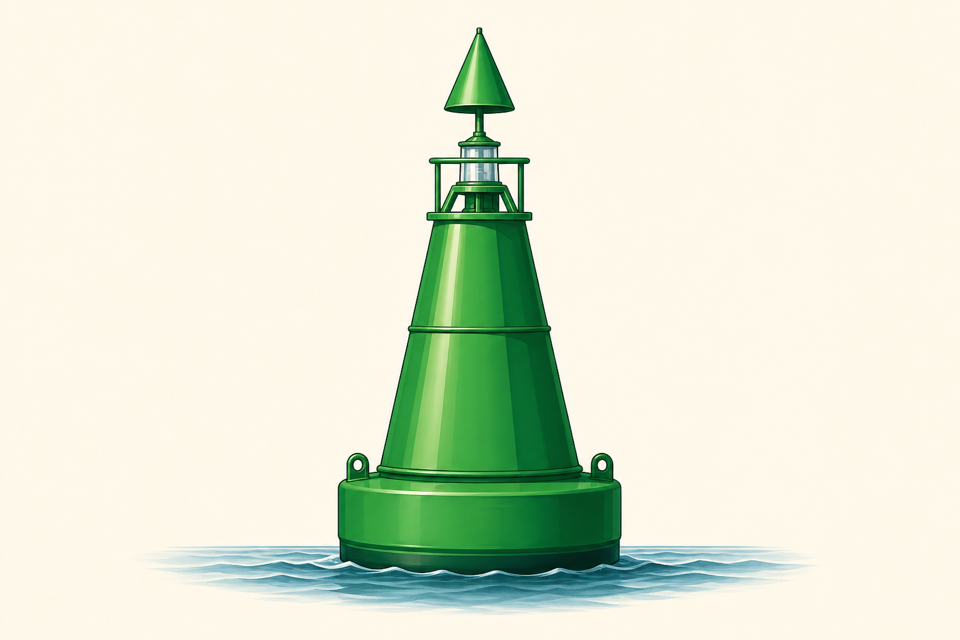
In Region A, a green conical starboard-hand mark is kept to starboard when following the conventional direction of buoyage. A red can-shaped port-hand mark is kept to port. If you travel the other way, the marks do not change identity; your direction changes.
Cardinal marks point to safer water
A cardinal mark names the side of the mark on which safer water lies. A South cardinal mark directs you south of it. Its black cone topmarks both point down, and the body is yellow above black. The chart still matters because a mark does not promise a safe route for every vessel or tide.
A safe-water mark has a different job
Red and white vertical stripes and a red sphere topmark identify a safe-water mark. It indicates navigable water around the mark, often on a channel centreline or landfall approach, rather than one edge of a channel.
Worked example: entering a harbour
You are entering a harbour from seaward in Region A and see a green conical buoy ahead. First confirm the charted channel and direction of buoyage. The green mark identifies the starboard-hand side of that channel in the conventional direction. Keep it to starboard as you pass, allowing for the charted depth, your draught, and the conditions.
Remember the direction first, then the colour and shape.
A common mistake
Treating “red to port” as a rule for every passage. It describes the conventional direction in Region A, usually entering from seaward. It does not tell you which side to leave a mark when departing.
Try three questions
These are independent practice questions. Read the answer and explanation after making your choice.
01You are entering a harbour in IALA Region A. Which side should you leave a green conical buoy?
Answer: To starboard (right)
In IALA Region A (Europe), green conical buoys are starboard-hand marks when entering harbour from seaward, and should be left to starboard.
02A buoy is painted yellow above black, with two black cones pointing downward. What does it mark?
Answer: South cardinal mark — safe water lies to the south
Two cones pointing down with a yellow-over-black body is a South cardinal mark. The safe water lies to the south of the mark.
03What does a red and white vertically striped buoy with a single red sphere topmark indicate?
Answer: Safe water mark — pass either side
Vertical red and white stripes with a red spherical topmark is a safe water mark, often found at landfall or mid-channel. There is navigable water all around it.
Sources and further reading
Examples checked against these primary sources on 27 September 2026. Check the latest editions before using any rule or calculation afloat.
Skipper Study is independent and is not affiliated with or endorsed by the RYA. How we prepare these questions.